جهتگیری کارآفرینی، سازوکار یادگیری و عملکرد: نقش قابلیتهای پویای مبتنی بر دانش
کلمات کلیدی:
جهتگیری کارآفرینی, سازوکار یادگیری, قابلیتهای پویای مبتنی بر دانش, عملکرد, پایداری کسبوکارچکیده
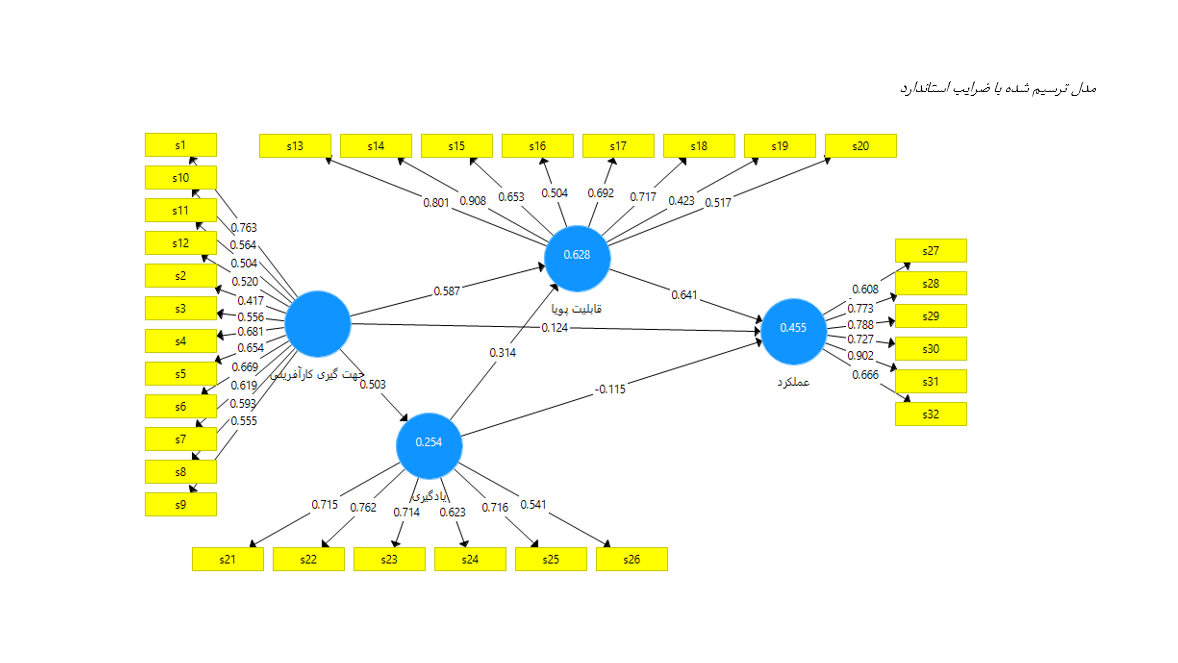
هدف این پژوهش بررسی اثر جهتگیری کارآفرینی و سازوکار یادگیری بر عملکرد کسبوکارها با توجه به نقش میانجی قابلیتهای پویای مبتنی بر دانش در رستورانهای شهر مشهد است. پژوهش حاضر از نظر هدف کاربردی و از نظر روش توصیفی–همبستگی است. جامعه آماری شامل رستورانهای فعال در حوزه غذاهای فانتزی و پیتزا در شهر مشهد بود که از میان ۳۸۰ واحد صنفی، ۱۹۰ مدیر به روش نمونهگیری در دسترس انتخاب شدند. ابزار گردآوری دادهها پرسشنامههای استاندارد جهتگیری کارآفرینی، سازوکار یادگیری، قابلیتهای پویای مبتنی بر دانش و عملکرد بود. تحلیل دادهها با استفاده از نرمافزارهای SPSS و SmartPLS و بهکارگیری مدلسازی معادلات ساختاری مبتنی بر حداقل مربعات جزئی انجام شد. نتایج تحلیل معادلات ساختاری نشان داد که جهتگیری کارآفرینی اثر مستقیم معناداری بر عملکرد ندارد (t=1.66)، اما اثر آن بر سازوکار یادگیری (β=0.503, t=10.84) و قابلیتهای پویای مبتنی بر دانش (β=0.587, t=13.88) معنادار و مثبت است. سازوکار یادگیری نیز بهطور مستقیم بر عملکرد اثر معناداری نداشت (t=1.59)، اما بر قابلیتهای پویای مبتنی بر دانش اثر مثبت و معنادار نشان داد (β=0.314, t=6.07). قابلیتهای پویای مبتنی بر دانش تأثیر قوی و معناداری بر عملکرد داشتند (β=0.641, t=7.66). همچنین نقش میانجی قابلیتهای پویای مبتنی بر دانش در رابطه بین جهتگیری کارآفرینی و عملکرد (β=0.376) و بین سازوکار یادگیری و عملکرد (β=0.201) تأیید شد. یافتهها نشان میدهد که جهتگیری کارآفرینی و یادگیری بهتنهایی تضمینکننده بهبود عملکرد نیستند، بلکه از طریق توسعه قابلیتهای پویای مبتنی بر دانش به عملکرد منجر میشوند و تقویت این قابلیتها مسیر اصلی دستیابی به مزیت رقابتی پایدار در کسبوکارهای خدمات غذایی محسوب میشود.
دانلودها
مراجع
Balochi, H., Maleki Min Bash Razgah, M., Feiz, D., & Hasangholipour, T. (2019). Investigating the Effect of Dynamic Capabilities on Organizational Performance with the Mediation of Marketing and Technical Capabilities and Examining the Moderating Role of Environmental Changes. Business Strategies, 16(13), 99-118. https://cs.shahed.ac.ir/article_2429.html?lang=en
Braganza, A., Brooks, L., Nepelski, D., Ali, M., & Moro, R. (2017). Resource management in big data initiatives: Processes and dynamic capabilities. Journal of Business Research, 70, 328-337. https://doi.org/10.1016/j.jbusres.2016.08.006
Cheng, C. C., Yang, C., & Sheu, C. (2016). Effects of open innovation and knowledge-based dynamic capabilities on radical innovation: An empirical study. Journal of Engineering and Technology Management, 41, 79-91. https://doi.org/10.1016/j.jengtecman.2016.07.002
Chien, S., & Tsai, C. (2021). Entrepreneurial orientation, learning, and store performance of restaurant: The role of knowledge-based dynamic capabilities. Journal of Hospitality and Tourism Management, 46, 384-392. https://doi.org/10.1016/j.jhtm.2021.01.007
Conboy, K., Mikalef, P., Dennehy, D., & Krogstie, J. (2019). Using business analytics to enhance dynamic capabilities in operations research: A case analysis and research agenda. European Journal of Operational Research, 281(3), 656-672. https://doi.org/10.1016/j.ejor.2019.06.051
Feranita, N. V., Dwimahendrawan, A., & Mayasiana, N. A. (2025). Identification of Dynamic Capability Elements for Women Entrepreneurs Performance Development to Achieve Gender Equality of SDG’s. JLSDGR, 5(3), e05448. https://doi.org/10.47172/2965-730x.sdgsreview.v5.n03.pe05448
Fuentelsaz, L., González, C., & González, M. (2024). Speed of pro-market reforms and entrepreneurial innovation. Small Business Economics. https://doi.org/10.5465/AMPROC.2023.16811abstract
García-Villaverde, P. M., Parra‐Requena, G., & Ruiz‐Ortega, M. J. (2017). From Pioneering Orientation to New Product Performance through Competitive Tactics in Smes. Business Research Quarterly, 20, 275-290. https://doi.org/10.1016/j.brq.2017.05.002
Gawke, J. C., Gorgievski, M. J., & Bakker, B. B. (2019). Measuring intrapreneurship at the individual level: Development and validation of the employee intrapreneurship scale. European Management Journal, 37, 806-817. https://doi.org/10.1016/j.emj.2019.03.001
Han, Y., & Li, D. (2015). Effects of intellectual capital on innovative performance: The role of knowledge-based dynamic capability. Management Decision, 53(1), 40-56. https://doi.org/10.1108/MD-08-2013-0411
Hanaysha, J. R., & Al-Shaikh, M. E. (2024). Impact of entrepreneurial orientation, marketing capability, and market orientation on business sustainability and corporate reputation. Discover Sustainability, 5, 273. https://doi.org/10.1007/s43621-024-00401-4
Huang, S., Huang, Q., & Soetanto, D. (2022). Entrepreneurial orientation dimensions and the performance of high-tech and low-tech firms: A configurational approach. European Management Journal, 41(3), 375-384. https://doi.org/10.1016/j.emj.2022.03.002
Lisboa, A., Skarmeas, D., & Saridakis, C. (2016). Entrepreneurial orientation pathways to performance: A fuzzy-set analysis. Journal of Business Research, 69(4), 1319-1324. https://doi.org/10.1016/j.jbusres.2015.10.099
Mamun, A. A., Mohiuddin, M., Fazal, S. A., & Ahmad, G. B. (2018). Effect of entrepreneurial and market orientation on consumer engagement and performance of manufacturing SMEs. Management Research Review, 41(1), 133-147. https://doi.org/10.1108/MRR-04-2017-0102
Mikalef, P., Boura, M., Lekakos, G., & Krogstie, J. (2019). Big data analytics capabilities and innovation: The mediating role of dynamic capabilities and moderating effect of the environment. British Journal of Management, 30(2), 272-298. https://doi.org/10.1111/1467-8551.12343
Nasehifar, V., Dehdashtishahrokh, Z., Taghavifar, M. T., & Farzaneh Hasanzadeh, J. (2019). Identifying the effective factors on entrepreneurial export from the perspective of dynamic capabilities: The case of food industry. Journal of International Business Administration, 1(3), 23-42. https://jiba.tabrizu.ac.ir/article_7588.html?lang=en
Nguyen, H. T. N., Han, J. W., & Pham, H. C. (2024). Joint effect of entrepreneurship and dynamic capabilities on firm performance: an empirical investigation among ICT-SMEs. Baltic Journal of Management, 19(1), 85-102. https://doi.org/10.1108/BJM-03-2023-0102
Nopasand Asil, S. M., Ramazanpour, E., & Attari Asl, P. (2016). The Impact of Marketing Capability, Innovation, and Learning on Organizational Performance (Case Study: Tabriz Petrochemical Company). Productivity management, 10(1), 95-124. https://sanad.iau.ir/en/Journal/jpm/Article/976097
Norouzi, H., Nosratpanah, R., & Esmaeilpour, E. (2022). The impact of dynamic capabilities on firm performance mediated by business model innovation and sustainable competitive advantage. Innovation Management and Operational Strategies, 3(3), 278-296. https://www.journal-imos.ir/article_146555.html?lang=en
Nosratpanah, R., Barani, S., Ashrafzadeh, A., & Atashi, G. (2025). The Impact of Dynamic Service Innovation Capabilities on Firm Performance: The Moderating Role of Perceived Environmental Dynamism and the Mediating Role of Service Innovation and Competitive Advantage. Journal of Business Management, 16(1), 137-166. https://jibm.ut.ac.ir/article_97036.html?lang=en
Pezeshkan, S. A., Fainshmidt, A., Nair, M. L., Frazier, E., & Markowski, E. (2016). An empirical assessment of the dynamic capabilities-performance relationship. Journal of Business Research, 69(8), 2950-2956. https://doi.org/10.1016/j.jbusres.2015.10.152
Protogerou, A., Caloghirou, Y., & Karagouni, G. (2014). The relevance of the dynamic capabilities perspective in low-tech sectors. In H. Hirsch-Kreinsen & I. Schwinge (Eds.), Knowledge-intensive entrepreneurship in low-tech sectors: The prospects of traditional economic industries (pp. 138-165). Edward Elgar Publishing. https://doi.org/10.4337/9781783472048.00015
Real, J. C., Rold'an, J. L., & Leal, A. (2014). From entrepreneurial orientation and learning orientation to business performance: Analysing the mediating role of organizational learning and the moderating effects of organizational size. British Journal of Management, 25(2), 186-208. https://doi.org/10.1111/j.1467-8551.2012.00848.x
Saeed, S., Yousafzai, S. Y., & Engelen, A. (2014). On cultural and macroeconomic contingencies of the entrepreneurial orientation-performance relationship. Entrepreneurship Theory and Practice, 38(2), 255-290. https://doi.org/10.1111/etap.12097
Scheuer, L. J., & Thaler, J. (2022). HOW do dynamic capabilities affect performance? A systematic review of mediators. European Management Journal, 41(6), 914-931. https://doi.org/10.1016/j.emj.2022.12.006
Scholten, K., Sharkey Scott, P., Scott, S. P., & Fynes, B. (2019). Building routines for non-routine events: Supply chain resilience learning mechanisms and their antecedents. Supply Chain Management: International Journal, 24(3), 430-442. https://doi.org/10.1108/SCM-05-2018-0186
Secundo, G., Turi, I. D., Garzoni, A., Posa, M., & Barile, D. (2025). Unveiling Knowledge Practices and Microfoundations of Knowledge-Based Dynamic Capabilities for Digital Transformation in SMEs Through Industry–university Perspective. Journal of Knowledge Management. https://doi.org/10.1108/jkm-02-2024-0244
Shah, S. S., & Asghar, Z. (2023). Dynamics of social influence on consumption choices: A social network representation. Heliyon, 9(6), e17146. https://doi.org/10.1016/j.heliyon.2023.e17146
Talari, M., Fallah, M. R., & Hoseinkhani, M. (2021). Investigating the Role of Entrepreneurial Orientation in the Success of New Products of Knowledge-Based Companies with an Emphasis on Ambidextrous Marketing. Journal of Modern Marketing Research, 11(1), 157-178. https://nmrj.ui.ac.ir/article_25449.html?lang=en
Tenggono, E., Soetjipto, B. W., & Sudhartio, L. (2025). Dynamic Managerial Capabilities In action: Advancing Strategic Agility and Digital Readiness in Healthcare Organizations. Journal of Organizational Change Management. https://doi.org/10.1108/jocm-12-2024-0772
Wang, C. L., & Ahmed, P. K. (2014). Dynamic capabilities: A review and research agenda. The International Journal of Management Reviews, 9(1), 31-51. https://doi.org/10.1111/j.1468-2370.2007.00201.x
Zare, H., Malabagher, A., & Karimi, A. (2024). Identifying Components of Dynamic Capabilities in Knowledge-Based Companies: A Review Through Bibliometrics. International Business Management, 7(2), 127-147.

دانلود
چاپ شده
ارسال
بازنگری
پذیرش
شماره
نوع مقاله
مجوز
حق نشر 2025 Amir Elahipour (Author); Mohsen Moradi

این پروژه تحت مجوز بین المللی Creative Commons Attribution-NonCommercial 4.0 می باشد.