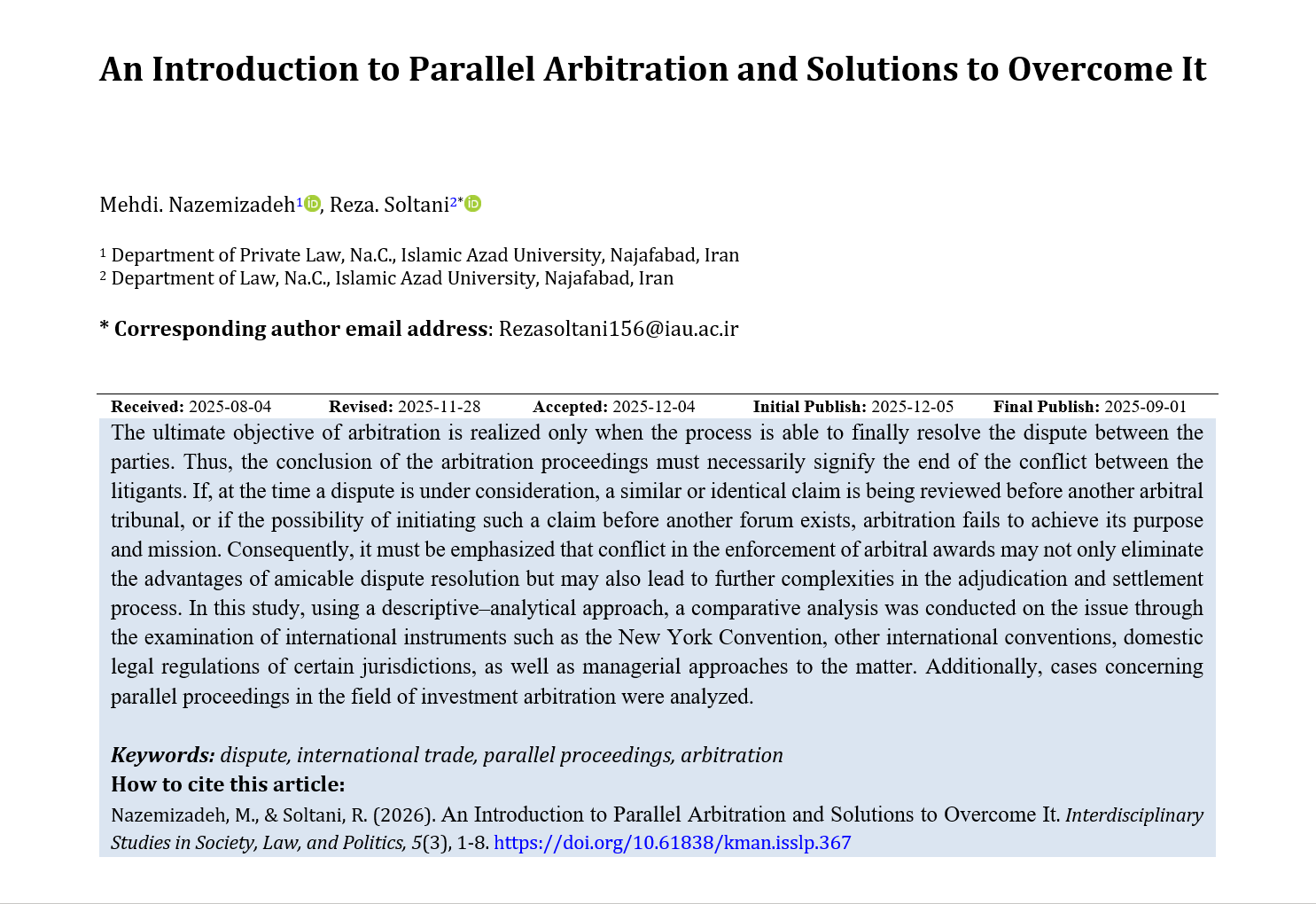
An Introduction to Parallel Arbitration and Solutions to Overcome It
Keywords:
dispute, international trade, parallel proceedings, arbitrationAbstract
The ultimate objective of arbitration is realized only when the process is able to finally resolve the dispute between the parties. Thus, the conclusion of the arbitration proceedings must necessarily signify the end of the conflict between the litigants. If, at the time a dispute is under consideration, a similar or identical claim is being reviewed before another arbitral tribunal, or if the possibility of initiating such a claim before another forum exists, arbitration fails to achieve its purpose and mission. Consequently, it must be emphasized that conflict in the enforcement of arbitral awards may not only eliminate the advantages of amicable dispute resolution but may also lead to further complexities in the adjudication and settlement process. In this study, using a descriptive–analytical approach, a comparative analysis was conducted on the issue through the examination of international instruments such as the New York Convention, other international conventions, domestic legal regulations of certain jurisdictions, as well as managerial approaches to the matter. Additionally, cases concerning parallel proceedings in the field of investment arbitration were analyzed.
Downloads
References
Akhlaghi, B., & Imam, F. (2020). Principles of International Commercial Contracts.
Ampal-American Israel, C., et al., & Arab Republic of, E. (2016). Decision on Jurisdiction CASE - ICSID Case No. ARB/12/11.
Council of International Law, B. (2004). Fall 2004 and Transnational Dispute Management, Volume 2, Issue 1, January.
Cremades, B., & Madalena, I. (2008). Parallel Proceedings in International Arbitration. Arbitration International, 24(4), 507-540. https://doi.org/10.1093/arbitration/24.4.507
Cremades, M., & Lew, J. D. M. (2005). Paralkl State and Arbitral Procedures in International Arbitration.
Dador, A. (2020). Justice in Antiquity. Abarkh Publications.
Darayi, M. H. (2006). An Introduction to National and International Commercial Arbitration. Rahbord Journal(Fall).
Dark, K. (2000). Theoretical Foundations of Archaeology. University Publication Center.
Dels, N. (2004). Sovereignty of Power or Sovereignty of Law. Contemporary Iran Publishing.
Dimsey, M. (2008). The Resolution of International Investment Disputes: Challenges and Solutions. Eleven International Publishing.
Dugan, C. F., Wallace Jr, D., Rubins, N. D., & Sabahi, B. (2008). Investor State Arbitration. Oxford University Press.
Forsten, D. (2015). Parallel Proceedings and the Doctrine of Lis Pendens in International Commercial Arbitration Uppsala University].
Forsten, P. (2015). ('[o]ther measures include, inter alia, anti-suit injunctions, consolidation of proceedings, and the application of the doctrine of forum non conveniens'). 43.
Gaillard, E., & Pinsolle, P. (2010). 'Advocacy in Practice: The Use of Parallel Proceedings'. Juris Net.
Greenberg, S., Kee, C., & Weeramantry, J. R. (2011). International Commercial Arbitration. Cambridge University Press. https://doi.org/10.1017/CBO9780511997365
Janeþková, P. (2017). LIS PENDENS BEFORE NATIONAL AND ARBITRATION COURTS. International Journal of Multidisciplinary Thought, 06(01), 291-300
ISSN - 2156-6992.
Orrego-Vicuna, F. (2005). 'Lis Pendens Arbitralis'. International Chamber of Commerce.
Pendens, I. L. A. (2009). Final Report on Final Report on Lis. Arb. Int'l, 25(1), 3. https://doi.org/10.1093/arbitration/25.1.3
Rivkin, D. W. (2005). 'The Impact of Parallel and Successive Proceedings on the Enforcement of Arbitral Awards'. International Chamber of Commerce.
Schreuer, C. H. (2001). The ICSID Convention: A Commentary.

Downloads
Additional Files
Published
Submitted
Revised
Accepted
Issue
Section
License
Copyright (c) 2025 Mehdi Nazemizadeh, Reza Soltani (Author)

This work is licensed under a Creative Commons Attribution-NonCommercial 4.0 International License.